














News

Cherokee Nation
Posted: Feb 25, 2026 2:18 PMUpdated: Feb 25, 2026 2:56 PM
Cherokee Nation Establishes Data Center Task Force

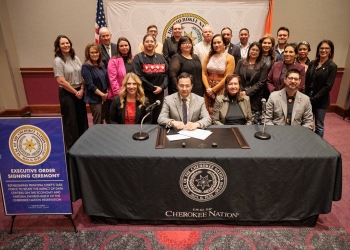
Cherokee Nation Principal Chief Chuck Hoskin Jr. signed an executive order Tuesday establishing a task force to study the environmental and economic impacts of data centers on the Cherokee Nation Reservation.
“Our culture teaches us to seek balance in all things” Hoskin said. “The explosive growth of generative AI and data centers, as well as the natural resources that fuel them and are impacted by them, may be products of the 21st century. But our long-standing Cherokee cultural teachings of balance and conservation must still apply.”
In 2024 Hoskin and Deputy Chief Bryan Warner established a task force on data sovereignty. Last year the task force recommended, and Chief Hoskin signed the tribe’s first policy on the responsible and ethical use of AI to improve governmental operations and the delivery of services to citizens.
The task force established on Tuesday examines the impact of the infrastructure driving AI across the tribe’s reservation.
“This new task force demonstrates that we understand that no use of technology is consequence free,” Warner said. “But we cannot begin to understand what policy options are available to Cherokee Nation to responsibly shape the future of AI and data centers by simply reacting. Instead, this calls for careful and balanced study.”
Hoskin’s executive order, published Wednesday on the tribe’s Cherokee.org website, poses a number of questions relating to data centers to the new task force, led by the tribe’s Secretary of Natural Resources Christina Justice.
Some of the questions Hoskin posed to the task force include:
- What is the present status and future outlook for the construction of data centers across the Cherokee Nation Reservation?
- What environmental concerns are associated with data centers?
- What economic opportunities or detriments do data centers present?
- What barriers or opportunities exist with respect to efforts by Cherokee Nation to mitigate any economic detriments or harm to the environment and its citizens relating to data center development or operations?
- What governmental policies relating to data center development or operations presently under consideration at the state or federal level should Cherokee Nation consider for advocacy?
- What efforts can Cherokee Nation undertake to better understand concerns, questions and opinions of its citizens relating to data center development and operations?
“Our team has already been studying many of these issues and we have informally heard perspectives from Cherokee citizens and a cross section of people and organizations across our reservation,” said Secretary of Natural Resources Christine Justice. “Chief Hoskin’s executive order on the environmental and economic impact of data centers helps sharpen our focus and formalizes our efforts as a high priority of the Hoskin/Warner Administration.”
The nine-member task force includes:
- Christina Justice, Secretary of Natural Resources (task force chair)
- Dr. Corey Bunch, Chief of Staff (task force co-chair)
- Andy McMillan, Cherokee Nation Businesses Director of Economic Development
- Ed Fite, Chair of the Cherokee Nation Environmental Protection Commission
- Paula Starr, Chief Information Officer
- Kim Teehee, Executive Director of Government Relations and Delegate to Congress
- Paiten Qualls, Deputy Attorney General
- Julie Hubbard, Communications Executive Director
- Dawni Squirrel, Cultural advisor to the Hoskin/Warner administration.
Hoskin’s order directs the task force to engage internal and external experts and solicit input from Cherokee Nation citizens. The task force will develop a process for receiving citizen input, including through the tribe’s online Gadugi Portal.
The order also directs the task force to seek balance across varying perspectives on the subject of data centers.
At Hoskin’s invitation, representatives from Honor the Earth and Indigenous Environmental Network joined Cherokee leaders for the signing.
Jordan Harmon, policy specialist at the Indigenous Environmental Network and Muscogee Nation citizen said she appreciates the Cherokee Nation Task Force’s input and exploration.
“When it comes to the implementation of AI and build out of Data Centers I hope that people can become more aware of the impacts on the land, water, and resources as well as the social and economic impacts of the data center build outs. I would like for people to be aware of the players and companies involved, their ethics and the way they work and the ways those can be in conflict with our Native values,” Harmon said.
Cherokee Councilor Dora Smith-Patzkowski, a member of the Council’s leadership, praised Chief Hoskin’s executive order.
“Our relationship with the land and water on the Cherokee Nation Reservation is not a dataset. Instead, it is a precious resource passed down through generations of Cherokee people. As AI becomes a powerful force in how natural resources are managed and monitored, we cannot afford to be observers,” said Patzkowski said. “This task force is about exercising our sovereignty in the digital age. It is about making sure that the tools shaping decisions over Cherokee land, Cherokee water, and Cherokee futures are informed by Cherokee knowledge and accountable to Cherokee people. That is the responsibility of leadership, and that is why this work matters, so I applaud Chief Hoskin, Deputy Chief Warner and my fellow Councilors for supporting this task force and its work.”
The task force report is due to Hoskin by June 30.
“In addition to taking a balanced approach to studying the impact of data centers, we need to understand that Cherokee Nation alone cannot shape the future of data centers and AI within our reservation,” Hoskin said. “But, if we are reactionary or if we refuse to engage in thoughtful study, we will place ourselves permanently on the sideline as infrastructure is built. We refuse to sideline ourselves on this important issue.”
Photo courtesy Cherokee Nation
« Back to News

